The first erogenous zone in the vagina was described by the German gynecologist Ernst Gräfenberg in the mid-20th century. In the early 80s, this place received the official name — the G-spot in honor of the "discoverer." Its popularity is due to Beverly Whipple, Alice Ladas, and John Perry, authors of the book The G Spot and Other Recent Discoveries About Human Sexuality, which became the main reference point in the history of the G-spot.
What is the G-spot
This term refers to an area on the front wall of the vagina, located about 5 cm from the entrance, behind the pubic bone and the urethra.
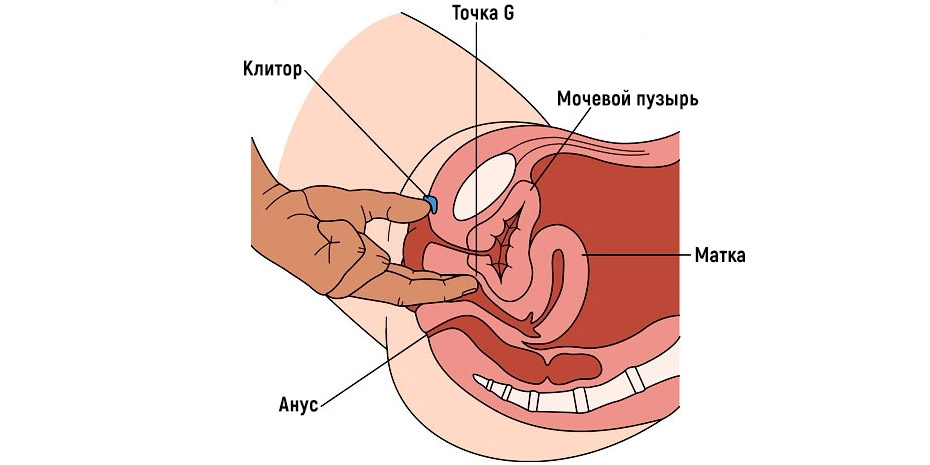
It is believed that there are many nerve endings in this zone. The G-spot is also called the female equivalent of the prostate. Its stimulation is said to lead to intense arousal, powerful orgasms, and female ejaculation.
There is an opinion that it is precisely because of the G-spot that women can experience vaginal orgasm.
However, opponents of this view argue that the G-spot is only an attempt to justify the importance of penetrative sex.
What science says
Debates about the existence of the Gräfenberg zone (another name for the G-spot) are ongoing. Since it was first mentioned, many scientific studies have been conducted: some proving the existence of the G-spot, others disproving it.
For example, scientists from the Royal College of London surveyed ORIGINAL RESEARCH—ANATOMY/PHYSIOLOGY: Genetic and Environmental Influences on self-reported G-Spots in Women: A Twin Study 1804 women twins and concluded that there are no physiological prerequisites for the existence of the G-spot. The sisters gave different answers to the question of the presence of this erogenous zone. And if it really existed, the anatomy of the twins and their answers would have to match.
At the same time, 56% of the study participants reported having the desired spot. The authors attributed this to subjective feelings.
Beverly Whipple criticized The real G-spot myth the work. The popularizer of the G-spot noted, in particular, that twins have different partners, hence their sexual experiences might not match.
Following the British study, another research was published Is the Female G-Spot Truly a Distinct Anatomic Entity? , which analyzed all scientific works on the G-spot from 1950 to 2011. The authors also stated that there is no objective evidence of the anatomical existence of an erogenous zone in the vagina.
But a few months later, American gynecologist Adam Ostrzenski made a sensational statement G-spot anatomy: a new discovery : he discovered that very spot, or rather an anatomical structure resembling a pouch, in the corpse of an 83-year-old woman.
Of course, this discovery was met with skepticism, if only because it concerns just one woman. But what about the 56% who confirmed the existence of the G-spot in the Royal College of London's survey?
So does the G-spot exist?
You can answer this question roughly as follows: some women (not all!) may have an erogenous zone in the vagina. But to say that this is some kind of separate anatomical structure or organ is not correct. Many specialists believe that this area is simply connected to the internal part of the clitoris — hence the pleasant sensations.
There is an area on the front wall of the vagina, stimulation of which is associated with sexual pleasure and orgasm for some, but not for all women. If you are a woman or have a female partner who wants to explore G-spot stimulation, keep this in mind. If you find it pleasurable, great. If not, don’t worry: the human body has plenty of places to explore.
In other words, does it really matter whether there is any specific point, zone, or organ? If a girl experiences pleasure from stimulating this area, don’t interrupt her. If there are no pleasant sensations, then there’s nothing to worry about: this zone is insensitive in a huge number of women. But it’s worth trying to find it: what if it works? And about how to properly stimulate this controversial spot, Loverssex' has already mentioned in the article about stream orgasm.