Seriously, are there female condoms?
Yes, there are. The female condom is a barrier method of contraception, technically the same as the male one. It is a thin, soft, form-fitting sheath with a flexible ring at each end. One side is closed.
The inner ring on the closed end is used for ease of insertion into the vagina and holding the condom in place during intercourse. The outer ring, on the other hand, remains outside the vagina and covers part of the external genitals.
Doctor Karina Bondarenko clarifies that the size of the female condom is usually one, but it can vary by different manufacturers. For example, the length of the FC2 sizes (the modern version of this contraceptive) ranges from 163 to 183 mm, and the width is 76 to 83 mm. The American "Wikipedia" advises Female condom women who have recently given birth to first try the larger size.
Who and why invented them?
“The female condoms were invented by Danish doctor Lasse Hessel. The first prototypes were created in the 1980s in response to the rapid spread of HIV infection in African countries,” says Doctor Bondarenko. “They were created with a single purpose – to protect women in developing countries, the third world, from the consequences of male aggression and violence. From unwanted pregnancy and from sexually transmitted infections during sexual intercourse with a partner who does not want to use male condoms.”
According to Bondarenko, the UN Population Fund distributed them free to women in these countries. Then the Food and Drug Administration (FDA) approved the release and use of the first version of female condoms (FC1) in the United States in 1993. That is, they went on sale almost 25 years after their creation.
FC1 was made of polyurethane, they were extremely uncomfortable, often fell out, and made various unpleasant sounds due to friction during intercourse.
“In 2009, they were completely replaced by female condoms of the second version (FC2), made from a more elastic and thinner material — nitrile, which significantly improved their quality,” said Doctor Bondarenko.
Currently, in various countries, female condoms made of nitrile (based on a synthetic rubber analog) and latex (made from rubber) are available for sale.
Why didn't they become popular?
According to Meet Our Advocates: Dr. Dawn Bingham obstetrician-gynecologist Dawn Bingham, one of the reasons for the extremely low popularity of female condoms is the lack of a competent advertising campaign, which, in turn, is difficult to implement technically.
Demonstrating how to use a male condom is easy on any phallic-shaped object, even without an erotic subtext: everything is clear and visual on a banana.
For demonstrating the use of a female condom, you have to use images of genitals in section, which looks like a real problem for large-scale distribution. Tampons once failed to be sold for this same reason.
If there are accessible male condoms that have been used for centuries, the choice is obvious. The authors of the Vox site tried to buy female condoms, traveled halfway across the city, and found them in no pharmacy.
It turned out that there is only one manufacturer of female condoms in the USA, which can only be purchased on their website. By the way, a male author did not need to even leave the building where he works to buy male condoms.
“Female condoms are undervalued, just as the benefits of tampons were once undervalued. At the dawn of their appearance, in the 1930s, only 4-6% of women used them,” says Doctor Bondarenko. “This problem, in my opinion, is bipolar: on one hand, female condoms are a way of protection for disadvantaged women from the third world, on the other hand, are an attribute of feminism, a necessity for a woman who regulates her own sexual life and childbearing and protects herself from infections, not relying on decisions made by sometimes unconscious (and perhaps infected) sexual partners.
The emergence of the female condom is a tangible right of every woman to independence in sexual matters and a small but significant victory on the path to gender equality.
In my experience, information about the existence of female condoms is likely known to one-third to half of my patients. Only a few know about the technique of using them. And to be honest, not every obstetrician-gynecologist is fully familiar with, for example, the rules for inserting and removing a female condom, as you will not find such certified products authorized for sale in the Russian Federation in pharmacy networks.
According to Bondarenko, another limitation hindering the wide distribution of female condoms for regular use is their relatively high cost—2 to 3 times higher than their male counterparts.
“A significant factor preventing a young woman from even starting to think in this direction, in my opinion, is the apparent complexity of inserting the female condom, although the instructions are very simple and available for free, for example, on the site of the Centers for Disease Control and Prevention. And it is designed for an absolutely ordinary person,” says Bondarenko.
According to researchers Contraceptive Use in the United States , women aged 15-45 in the USA are sterilized more often than they use female condoms: 15% versus 0.2%. Moreover, 0.2% is the item “other methods,” which includes not only female condoms.
In another study Female condom use among women at high risk of sexually transmitted disease , aimed at popularizing female condoms, observations showed the following results: by the end of the study, 8% of participants used exclusively female condoms, 15% used exclusively male condoms, and 73% used both types of condoms.
How effective are female condoms?
Doctor Bondarenko explains that female condoms, along with male condoms, are barrier methods of contraception based on a mechanical barrier that prevents the meeting of sperm and egg.
The effectiveness of any method of contraception is evaluated by the Pearl index – this is the failure rate, which is equal to the number of unplanned pregnancies during one year for 100 women using this or that contraceptive method. The lower this indicator, the more reliable the contraceptive method.
“But it is necessary to distinguish between the effectiveness of the method when used ideally and in reality. It is considered that the ideal Pearl index for female condoms is about 5 (for male condoms, about 2),” says Bondarenko. “However, for the ideal use of any method, all conditions and recommendations for its use must be met, from all timing requirements to technique.
Undoubtedly, a certain experience is required for this, usually accumulated with age, and the lack of necessary skills will increase the likelihood of pregnancy even when using very effective contraceptive methods, which are female condoms.
If we speak of the actual effectiveness of protection against unwanted pregnancy of male and female condoms, it is generally comparable and is around 80%.”
Female condoms also cover a broader area than male ones What are female condoms and how are they used? . Thus, they can provide additional protection against diseases of the vulva, perineum, and base of the penis.
How to use them?
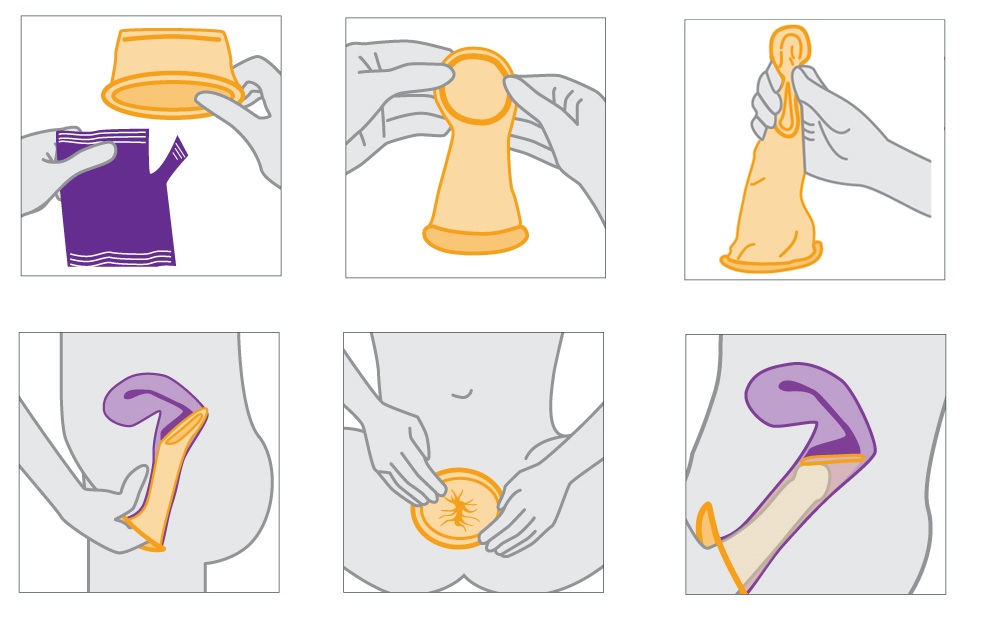
1. Preparation
Check the expiration date on the packaging. If everything is in order, open the packet and carefully take out the female condom, trying not to tear it. Do not open the packet with your teeth.
The female condom is already lubricated, but you can add more lubricant if you want. Doctor Karina Bondarenko adds that female condoms necessarily imply the use of lubricants applied inside the condom or on the penis.
Depending on the material the female condom is made from, different types of lubricants can be used. Water-based or silicone-based lubricants are safe to use with any female condoms.
Oil-based lubricants cannot be used simultaneously with latex condoms, as they destroy latex.
2. Insertion
Relax and take a comfortable position. Standing with one leg on a chair, lying down, or squatting—any position where you are used to inserting a tampon will do.
Squeeze the smaller ring at the closed end of the condom and insert it into the vagina, just as you would insert a tampon.
Insert the inner ring into the vagina as far as possible, up to the cervix.
Insert your finger into the condom to straighten it, push it further, and check that it is not twisted.
Make sure that the large ring on the open end of the condom covers the area around the vaginal opening. That's it, now you can leave the condom inside for up to 10 hours.
3. Sex
Make sure the penis enters the condom, not between the condom and the side of the vagina.

4. Removal
After sex, immediately remove the condom. Start by twisting the outer ring to keep the sperm inside the bag.
Carefully pull out the condom, trying not to spill the sperm.
Throw the condom in the trash bin, not in the toilet.
Are there any risks?
According to Doctor Karina Bondarenko, in some cases, the use of female condoms may cause irritation of the vagina, vulva, penis, or anus.
“Sometimes [such a condom] reduces sensations from intercourse, but on the other hand, it can improve the quality of sexual relations due to the fact that the outer ring of the condom can additionally stimulate the clitoris or penis during vaginal coitus. There is also a small risk of it slipping into the vagina or anus or falling out during intercourse, which decreases the level of protection against both unwanted pregnancy and sexually transmitted infections,” summarizes Bondarenko.
What are their advantages and disadvantages?
Pros
- When used correctly, female condoms are 95% effective How effective are female condoms? (male condoms are 98% effective How effective are condoms? ).
- Protect against Female condoms pregnancy and sexually transmitted infections (STIs), including HIV.
- Made from safe materials.
- Easy to use.
- Can be inserted 8-10 hours before sex, saving time during foreplay.
- Can be used duringmenstruation.
- Can be used with spermicide (a contraceptive that destroys sperm).
- Can be used by people with latex allergies.
- The female condom does not require the male erection to hold it in place.
- Controlled by the woman.
Cons
- When used incorrectly, female condoms are 79% effective How effective are female condoms? (male condoms are 85% effective How effective are condoms? ).
- More research is needed to claim 100% effectiveness against STIs What are female condoms and how are they used? .
- The condom may go too far into the vagina, but it is easy to remove if this happens.
- May not be suitable for women who find it uncomfortable when something touches their genital area (the outer ring of the female condom will rest on the vulva).
- If a woman has any reproductive tract infections (candidiasis, bacterial vaginosis), the insertion of the condom 8-10 hours before sex may cause an intensification of odor, itching, discharge, and so on. So Doctor Bondarenko recommends inserting the condom just before sex in such cases.
- Experts Female condoms for anal sex have not reached a consensus on whether female condoms can be used for anal sex. Technically, this is possible, but there have been difficulties with insertion and slippage. Since female condoms are thinner than male ones, they have been found to tear, and respondents have complained of stronger pain sensations than with regular condoms, and bleeding in the receiving partner.
- A rustling sound during intercourse is still possible.
Read also
- Guide to contraception: how and what to protect yourself →
- STIs: diseases you were too embarrassed to ask about →
- Just putting on a condom is not enough. 7 non-obvious mistakes of protected sex →