According to statistics, 85–90% of adolescents who consult doctors for preventive purposes or with questions regarding puberty, hygiene, and health are girls.
Boys, and then men, usually consult urologists and andrologists in critical situations and rarely ask questions about their body's structure. Extremely rarely Rosen D. S., Rich M., editors. The Adolescent Male. Adolescent Medicine: State of the Art Reviews. Philadelphia: Hanley & Belfus; 2003. p. 3 specialists consider it necessary to explain this themselves and even more rarely have the tact to do so.
Therefore, before we delve deeper into penises, here is a brief education on male puberty.
How puberty in boys proceeds
Puberty occurs according to a fairly consistent and predictable scenario, despite the fact that its onset and duration depend on genetics, nutrition, health status, and psychological factors Tanner J. M. Sequence, tempo and individual variation in growth and development of boys and girls aged from twelve to sixteen. In: Kagan J, Coles R, editors. Twelve to Sixteen: Early Adolescence. New York: Norton; 1972. pp. 1–24 .
Averaged indicators are such: 98% of North American boys begin puberty between the ages of 9 and 14, on average at 11–12 years (approximately two years later than girls).
The process is divided into five stages Tanner J. M. Growth at Adolescence. Oxford: Blackwell Scientific; 1962 , which proceed approximately as follows:
- The testicles increase in volume (up to 4 ml or more) and length (2.5 cm or more).
- The penis increases in size. First in length, then in diameter. Pubic hair begins to grow.
- About a year after the increase in testicle volume, the first ejaculation occurs.
- The rate of growth increases (the peak rate is from 5.8 cm per year to 13.1 cm per year), the voice changes. Gynecomastia may begin—thickening of the mammary glands, often painful. It resolves itself within 1–2 years, occurring in 70% of boys.
- Hair grows on the face and under the arms.
The process concludes with fully transformed testicles—ranging from 15 to 25 ml in volume and from 4 to 6 cm in length.
After the onset of the first stage, it usually takes four years to complete puberty Tanner J. M. Foetus into Man: Physical Growth from Conception to Maturity. Cambridge: Harvard University Press; 1989 .
Delayed puberty is defined as the absence of signs of testicle enlargement in volume or length until age 15. This is a reason to consult a doctor, but not a reason to worry. In boys, delayed puberty occurs eight times more often than in girls and is often related to constitution or heredity.
Despite the fact that the problem often resolves itself, there is still a risk of illness, and researchers note a direct correlation between the emotional instability of the adolescent, academic difficulties, and delayed puberty.
The trigger is not the delay itself, but the lack of adequate information about what is happening, the boy's anxious conclusions, and worries Delayed puberty .
Precocious puberty is often a more significant cause for concern. It is characterized by the enlargement of the testicles before the age of 8 and the appearance of pubic hair before the age of 9 Precocious puberty . This always requires consultation with a doctor, and the risk of pathology here is greater than in girls with early development.
The psychological consequences are also significant. Researchers note that since such boys appear older than their peers, they face increased social pressure to conform to "adult" norms. Their cognitive and social development may lag far behind Garn S. M. Physical growth and development. In: Friedman SB, Fisher M, Schonberg SK, editors.Comprehensive Adolescent Health Care. St Louis: Quality Medical Publishing; 1992 their appearance. It is also known that such boys begin sexual activity earlier and are prone to risky behavior.
What is the penis and what is it for
The penis is a muscle that is formed in the womb from the same tissue as the clitoris. It fully develops during puberty.
It consists of several parts:
- The glans penis. In uncircumcised individuals, the glans is covered with pink moist tissue called the mucosa. Over it lies the foreskin. In circumcised individuals, the foreskin is removed, and the mucosa becomes dry skin.
- The paired corpora cavernosa are the tissues on the sides of the penis. These are filled with blood to cause an erection.
- The unpaired corpus spongiosum is the spongy tissue between the corpora cavernosa, which ends in the glans. It also fills with blood during an erection, keeping the urethra, which passes through it, open.
- The radix penis is the covered portion of the penis fixed to the front surface of the pubic bones.
- The urethra expels urine from the body as well as seminal fluid during ejaculation.
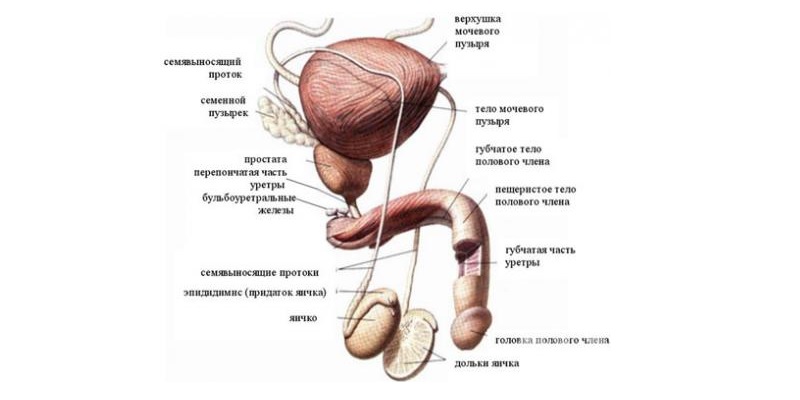
The functions of the male reproductive organs include the production and transportation of sperm, ejaculation, and the production of testosterone and other sex hormones responsible for maintaining the male reproductive system.
How penis size affects its functionality
Not at all. The exception is the micropenis: it is 2.5 times smaller than standard (up to 7 cm when erect). Micropenises occur in 0.6% of men Surgeons Pinch More Than An Inch From The Arm To Rebuild A Micropenis . It is important to remember that this is not normal but a pathological condition as a result of illness that is usually detected soon after birth. Most often this condition can be treated.
Pornography has created the impression that there are only small and large penises. But this is completely untrue. In shape and size, penises are as diverse as clitorises.
The average length of a flaccid penis is from 8 to 10 cm, although the entire range is much wider—from 5 to 15.5 cm. The average length of an erect penis is 15.1 cm, with a range of 11.4 to 19 cm.
There is an even wider range that includes uniquely known sizes of penises, so for a global sample, these numbers are not particularly useful, but for information: from 4 to 24 cm when flaccid, from 9 to 34 cm when erect.
In Russia, according to Evgeny Grekov, andrologist, urologist, head of the urology department at Professor Kalinchenko's Clinic, the average figures are slightly different: from 11 to 21 cm when erect, with an average of about 14 cm.
There is no correlation between the size of the penis when flaccid and when erect.
Any penis, provided its owner has no diagnosis affecting its function, is capable of performing all its functions.
How penis size affects the ability to deliver and experience orgasm
Not at all. First, let’s prove this by looking at the ability to experience orgasm and ejaculation.
These are not just independent processes; they are physiologically distinct. The brain is responsible for orgasm, while the autonomic nervous system is responsible for ejaculation Levin R. Physiology of orgasm. In: Mulhall J. P., Incocci L., Goldstein I., Rosen R., editors. Cancer and sexual health. Springer Science; New York: 2011. pp. 35–48 .
A man's ability to experience orgasm depends on the same factors as in women: comfort, relaxation, readiness for what is happening, self-confidence, and many other parameters necessary for a specific person to achieve orgasm.
Research also shows that orgasm from deep prostate massage is more intense and longer-lasting than from stimulation of the penis: 12 Perry J.F. Do men have a G-spot? Aust Forum. 1988; pp. 37–41 contractions of the pelvic muscles versus 4–8 Hite S. The Hite report on male sexuality. Ballantine Books; New York: 1981 .
As men can ejaculate without experiencing orgasm, it raises the question of what provokes ejaculation. Even scientists cannot fully answer this. But they have discovered interesting details.
For example, it is known that dopamine plays a huge role in ejaculation. Researchers gave systemic injections of dopamine to rats, both conscious and anesthetized, and in both cases, ejaculation occurred. The same applied to other mammals.
So, ejaculation does not even require arousal and special intervention from the person himself: it is a complex process involving several anatomical structures with extensive neurochemical and hormonal regulation.
So, if your penis is healthy, it will ejaculate. Perhaps even without your consent.
Orgasm is also a complex but different physiological process that depends on your mood, desire, and comfort. And this can be influenced by your dissatisfaction with your body.
This is important to remember when talking about the ability to bring a partner to orgasm. A partner's orgasm also depends on psychological factors—this is first.
Secondly, most nerve endings are located 1–3 cm from the vaginal entrance, so many women do not feel deep penetration. One of the components of pleasure during penetration is the feeling of fullness, and it is achieved when nerve endings are engaged. Thus, there is no point in targeting areas where there are very few nerve endings.
And the attempt to fill the entire vaginal space with one's penis was humorously addressed by Dr. Lindsay Dough in one of her videos: "Children come out of there; you cannot compete with that in size."
Urologist Evgeny Grekov also confirms this information: "The length of the penis does not affect the quality of sex. However, its hardness and the mutual consent of participants in the process do matter. Friction at the entrance to the vagina is necessary for orgasm, and for that, only penis hardness is required."
Nevertheless, survey results show that only 55% Penis size. of men are satisfied with the length and girth of their penis (interestingly, 85% of women are completely satisfied with their partner's penis size).
However, individual owners of a penis longer than 19 cm find it more difficult than one might think.
Not all partners agree to accept a large penis; they can literally get hurt even during careful sex. A large penis makes certain sexual acts more difficult and sometimes even excluded entirely oral sex. And even more: the body itself finds it harder to "raise" it, meaning to fill it with blood and achieve an erection. Moreover, if your sex life is limited to using the penis, it can be boring.
Just keep in mind that heterosexual girls experience fewer orgasms Differences in Orgasm Frequency Among Gay, Lesbian, Bisexual, and Heterosexual Men and Women in a U.S. National Sample than all other categories of people. And this is directly linked to the lower amount of oral sex in such couples.
On numerous forums or under the same video by Dr. Dough, people express themselves in a similar vein:
“I prefer to spend time in a well-managed small sports car rather than in a bus.”
“Dude, at 19, I had a penis 23 cm long and 7 cm wide. I only get to one stage in sex: 'I was curious.' Now I'm 30... Women really don't want such a large penis.”
“Guys with small penises, seriously? You have the ideal size for oral sex. No one really likes to choke on a penis, and almost everyone has a gag reflex.”